
There’s something sneaky happening inside your garage right now, and if you live anywhere near the Savannah coast, you might not notice it until your garage door suddenly refuses to open on a Monday morning.
Salt air is quietly eating away at your garage door springs, and it’s working a lot faster than most homeowners realize. The coastal environment around Savannah, Rincon, and Pooler puts your garage hardware through a kind of stress that inland homeowners simply never deal with. Humidity, heat cycles, and airborne salt particles team up to break down metal components well before their expected lifespan.
The good news is that understanding this problem puts you ahead of it. In this post, we’ll walk through exactly what salt air does to garage door springs, how to spot the warning signs before a spring snaps, and why professional garage door spring replacement is almost always the smarter and safer call over a DIY fix. We’ll also cover realistic costs, how long springs actually last near the coast, and a simple maintenance routine that can save you from an expensive emergency down the road.
What Salt Air Actually Does to a Garage Door Spring
Garage door springs are made from raw steel, so manufacturers ship them with a zinc coating that acts as a sacrificial barrier, corroding in place of the steel underneath. In a typical inland environment, that coating holds up reasonably well.
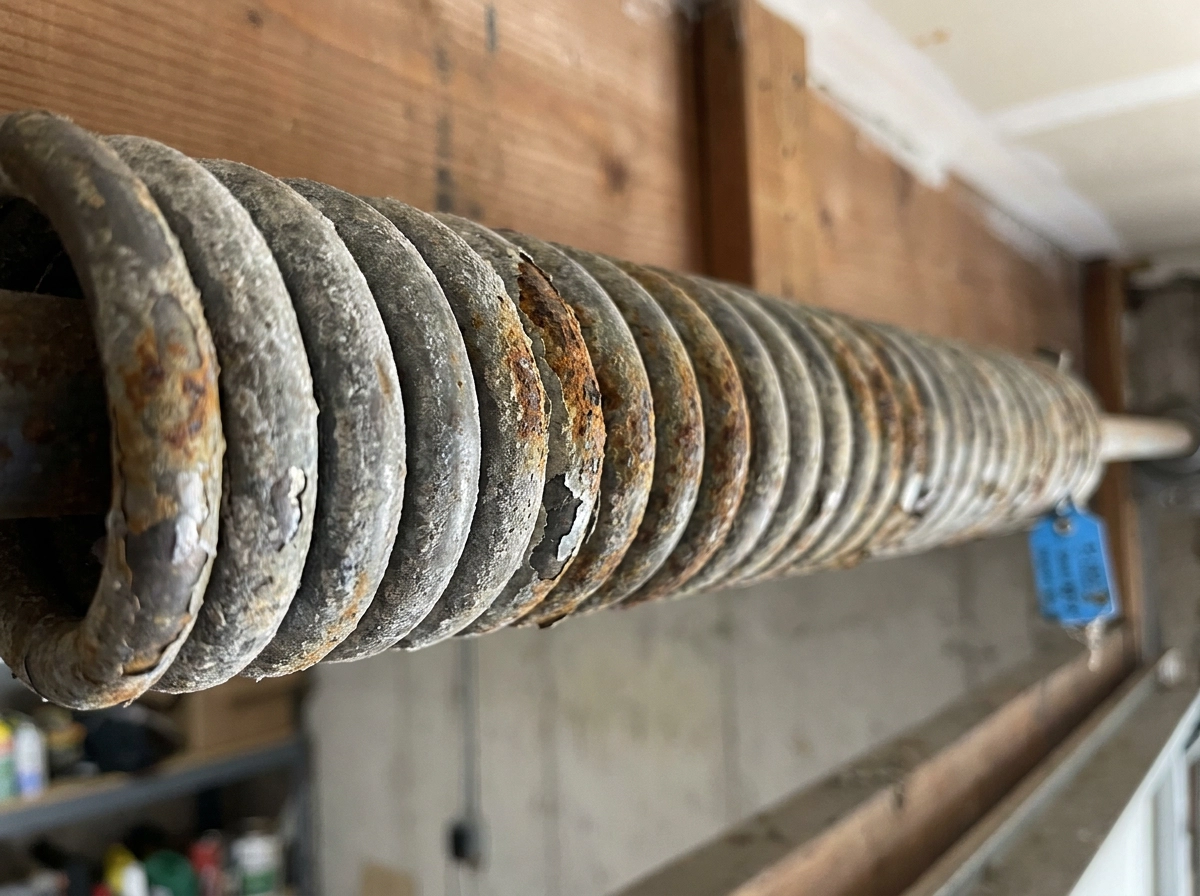
Airborne sodium chloride particles carried inland on humid coastal Georgia air land on metal surfaces and dissolve into the thin moisture film that’s almost always present near the coast. That salt-moisture solution acts as an electrolyte, triggering electrochemical oxidation that strips zinc coatings far faster than ordinary humidity alone. Once the zinc is gone, exposed steel reacts with oxygen and water to form iron oxide, ordinary red rust.
Red rust is not a cosmetic issue on a garage door spring. Every corroded coil loses metal from its cross-section, and a thinner cross-section carries less load. A spring rated for a specific door weight is no longer operating at that rating once rust takes hold.
Salt residue behaves hygroscopically, drawing moisture back to the metal surface even when the garage appears dry, meaning the corrosion process continues between uses. Salt that settles between spring coils holds moisture against the metal even after the garage looks dry.
This is worth understanding because how the coast affects your garage door hardware is a genuinely different story than what happens in drier climates. A spring failing from normal use cycles has simply run out of mechanical life. A spring corroding in salt air is being chemically compromised, often years before it would otherwise wear out. The manufacturer’s rated lifespan assumes the zinc stays intact. Near the Georgia coast, that assumption doesn’t hold.
Coastal Georgia Makes It Worse: Savannah, Rincon, and Pooler Specifics
Savannah’s climate actively accelerates every step of that corrosion chemistry.
Savannah’s humid subtropical climate means moisture is nearly constant through much of the year, so salt particles on your spring coils almost never fully dry out. Moisture is the activating ingredient that keeps the electrochemical process running, and coastal Georgia supplies it constantly.
Temperature swings compound the problem. Hot summers and cooler winters put springs through repeated expansion and contraction cycles. On an already-corroded spring, that flexing opens hairline cracks in the coil surface, creating reservoirs for salt and moisture that are nearly impossible to clean out.
Then there’s hurricane season, June through November. Storm-force winds load a garage door beyond its normal operating range, stressing springs that may already be compromised. When power goes out, homeowners switch to manual operation, placing stress directly on hardware never meant to carry that load without the opener’s mechanical assist. A marginal spring may not survive the week after a storm.
Location within the region matters. A property near a tidal marsh in Pooler, or a few blocks from the Wilmington River in Savannah, accumulates salt faster than a home ten miles inland in Rincon, even sharing the same ZIP code.
None of this is reflected in the 7-10 year ratings manufacturers publish, which assume typical inland conditions, not coastal salt exposure. For practical guidance, the Savannah garage door maintenance guide for coastal weather covers what actually applies here.
Torsion Springs vs. Extension Springs: Which Fails First in Salt Air
Both spring types are vulnerable, but they fail differently, and that difference matters for safety.
Torsion springs sit horizontally above the door on a metal shaft, storing rotational energy as the spring winds tight. When a salt-corroded coil fractures, that stored energy releases all at once. A snapping torsion spring is not a quiet event, and anyone nearby is at genuine risk.
Extension springs run along the horizontal tracks on either side of the door and stretch under load rather than twist. Corrosion attacks the exposed coils, but the more common coastal failure point is the S-hooks at each end. When a corroded hook gives way, the door can drop without warning.
Torsion springs have a specific vulnerability worth understanding. Tightly wound coils sit close together, and the narrow gaps trap salt and moisture. That trapped material keeps corroding the interior even when the spring looks intact from the outside. You can see nothing alarming on the exterior while the inner coils are already compromised.
This is why a spring that appears functional may be carrying far less load than it was rated for. Corroded metal behaves unpredictably under tension. Learning how to detect broken or weakened garage door springs is a useful starting point, but a professional assessment is the only reliable way to evaluate residual strength.
Warning Signs Coastal Homeowners Should Know
Knowing the failure modes matters less if you can’t spot the warning signs before something actually breaks. Here’s what to look for.
Rust-colored discoloration on the coils is the first thing to check. Orange or reddish-brown streaking on your spring means the zinc coating is already gone and bare steel is actively corroding. In Savannah’s salt air, that’s not a cosmetic issue you can defer. The degradation is happening right now, every time humidity cycles through the garage.
A grinding or scraping noise in the first few seconds of operation is worth taking seriously. That sound often points to corroded rollers or a spring shaft with salt buildup affecting smooth movement. It’s easy to tune out, but it usually means friction has increased beyond normal tolerances.
Watch how the door moves, not just whether it moves. If one side rises faster than the other, one spring has likely lost more tension than its counterpart. The door compensates by leaning on the stronger spring, which accelerates wear on both sides simultaneously.
Lift the door manually a few inches. A properly balanced door should feel relatively light. If it feels like you’re lifting the door’s full weight, the springs are losing their ability to counterbalance it.
A visible gap in a spring coil is not a wait-and-see situation. In a coastal environment, a separated coil means the rest of the spring is likely corroded too. Failure is close.
After any significant storm, do a quick visual check, especially if you ran the door manually during a power outage. Salt concentration in the air spikes in the hours following a storm, and manual operation puts real strain on springs that corrosion has already weakened.
How Long Do Springs Actually Last Near the Coast
Knowing the warning signs is useful. Knowing how much time you actually have before those signs appear is more useful.
The standard rating for residential garage door springs is 7 to 10 years, or roughly 10,000 to 20,000 cycles depending on the spring grade. That rating assumes moderate humidity, no salt exposure, and clean metal operating under its rated load. In other words, it assumes Atlanta, not Savannah.
In coastal Georgia, springs frequently need replacement before that window closes. The corrosion process described earlier does not just stain the metal; it reduces the effective strength of each coil. A spring rated for 10,000 cycles assumes the steel stays intact through all 10,000. Once corrosion thins the coil cross-section, the metal can reach its structural limit well before the rated cycle count.
The practical takeaway: treat the 7-year mark as a planning prompt, not a deadline. Scheduling a proactive spring replacement and maintenance review before failure happens costs less than an emergency call-out, and you control the timing.
Why DIY Spring Replacement Is a Bad Idea, Especially Here
Torsion springs sit under significant tension at all times. That stored mechanical energy has to go somewhere when you start working, and without the right tools and training, it goes into whatever is in the way. The U.S. Consumer Product Safety Commission has warned about garage door accident risks for decades, and spring failures are a consistent factor in serious injuries.
A corroded spring adds unpredictability a new one doesn’t have. Internal fractures from rust are invisible from the outside. A spring that looks intact can fail mid-adjustment, mid-wind, or the moment you release a clamp.
Torsion spring replacement requires specialized tools and technique; extension spring work carries its own documented risks. Both are explicitly flagged by the CPSC as hazards for untrained individuals.
There’s also a sizing issue specific to coastal homes. If a wood door has absorbed moisture and gained weight, or hardware has changed due to corrosion, a spring sized off the door’s original specs may be wrong from the start. A professional will account for actual current door weight. If you’ve noticed other signs that something is off, this overview of when your garage door needs a tune-up or replacement is worth reading before you make any decisions.
What Professional Garage Door Spring Replacement Costs and Covers
So what does professional replacement actually cost, and what do you get for it?
Costs vary by spring type and door weight; get a written quote from your technician. Double-car doors with two-spring systems run higher than single-car jobs. Emergency or after-hours calls carry a premium, confirm the exact surcharge when you book. That premium disappears entirely if you schedule the work before the spring fails. A proactive residential garage door spring replacement that fits your schedule will almost always cost less than the same job called in on a Sunday morning when the door won’t open.
Professional replacement also covers more than just swapping the spring. A technician will size the new spring to the actual weight of your door, inspect cables and replace them if corrosion warrants it, lubricate moving parts with marine-grade products suited to the salt-air environment, and run a safety check on the auto-reverse mechanism.
Annual maintenance visits run about 30 minutes and cost considerably less than a single spring replacement. They catch early corrosion, clear salt buildup before it causes binding, and give a technician the chance to flag a spring that’s approaching the end of its coastal lifespan before it snaps.
The comparison is simple: one scheduled replacement plus one annual visit costs less, and causes far less disruption, than a single emergency call-out. And when you’re already replacing springs, specifying powder-coated or corrosion-resistant hardware extends the next service interval. Coastal installers increasingly treat that as standard practice rather than an upgrade.
A Practical Maintenance Schedule for Coastal Garage Doors
Knowing the cost is useful. Knowing when and how to act on that information is what actually protects your hardware.
For most coastal Savannah-area homes, one professional tune-up per year is the baseline. If your home sits within a mile or two of tidal water, marshland, or the open coast, twice-yearly service is more appropriate. Corrosion rates at that proximity are meaningfully faster, and a lot can change between annual visits.
After any significant storm between June and November, inspect the spring coils, cables, and rollers for fresh surface rust, displaced or slack cables, or hardware that has visibly shifted. If something looks wrong, call a technician rather than adjusting anything yourself.
Marine-grade silicone or lithium-based lubricant is the right product for this environment; confirm your technician’s product choice at each visit.
Keep the garage door closed during and after heavy weather when you can. Salt concentration in the air spikes in the hours following a storm, and an open door gives hardware direct exposure when it’s most vulnerable. Summer weather in coastal Georgia brings extra wear on the whole system, not just the springs.
If your springs are approaching or past the lower end of the typical 7-10 year range, raise the question of replacement timing at your next service visit. Don’t wait for a failure to force the decision.
The Short Version for Savannah-Area Homeowners
All of the specifics covered above come back to one straightforward reality: salt air is an active chemical process, not a slow background inconvenience. If your garage door springs are anywhere near the Georgia coast, that process is happening right now, between uses, with the door closed.
The 7-10 year manufacturer rating was never calculated for Savannah’s humidity, salt exposure, or the added stress of hurricane season. Coastal homeowners should treat it as a rough upper bound, not a finish line to wait for.
Visible rust, grinding sounds, uneven movement, or a door that feels heavier than it should are all reasons to call a technician promptly rather than monitor and revisit.
Scheduled replacement and annual maintenance remove the safety risk and cost less than a single emergency call-out.
Action OHD has been serving Savannah, Rincon, Pooler, and the surrounding coastal Georgia communities since 1990. If your springs are approaching or past the lower end of the typical 7-10 year range, or you have noticed any of the warning signs above, scheduling an inspection is the practical next step. There is no reason to wait for a failure when a planned service visit costs less and avoids the disruption entirely.
Conclusion
Living on the Georgia coast comes with real trade-offs, and accelerated spring wear is one of them. Salt air does not wait, and neither should you.
Action OHD has spent more than three decades helping Savannah-area homeowners stay ahead of exactly these problems. If your springs are approaching or past the lower end of the typical 7-10 year range, or something about your door does not feel right, now is the time to act. Schedule an inspection, skip the emergency call, and keep your garage door working the way it should. A small investment in maintenance today protects your home, your budget, and your peace of mind tomorrow.